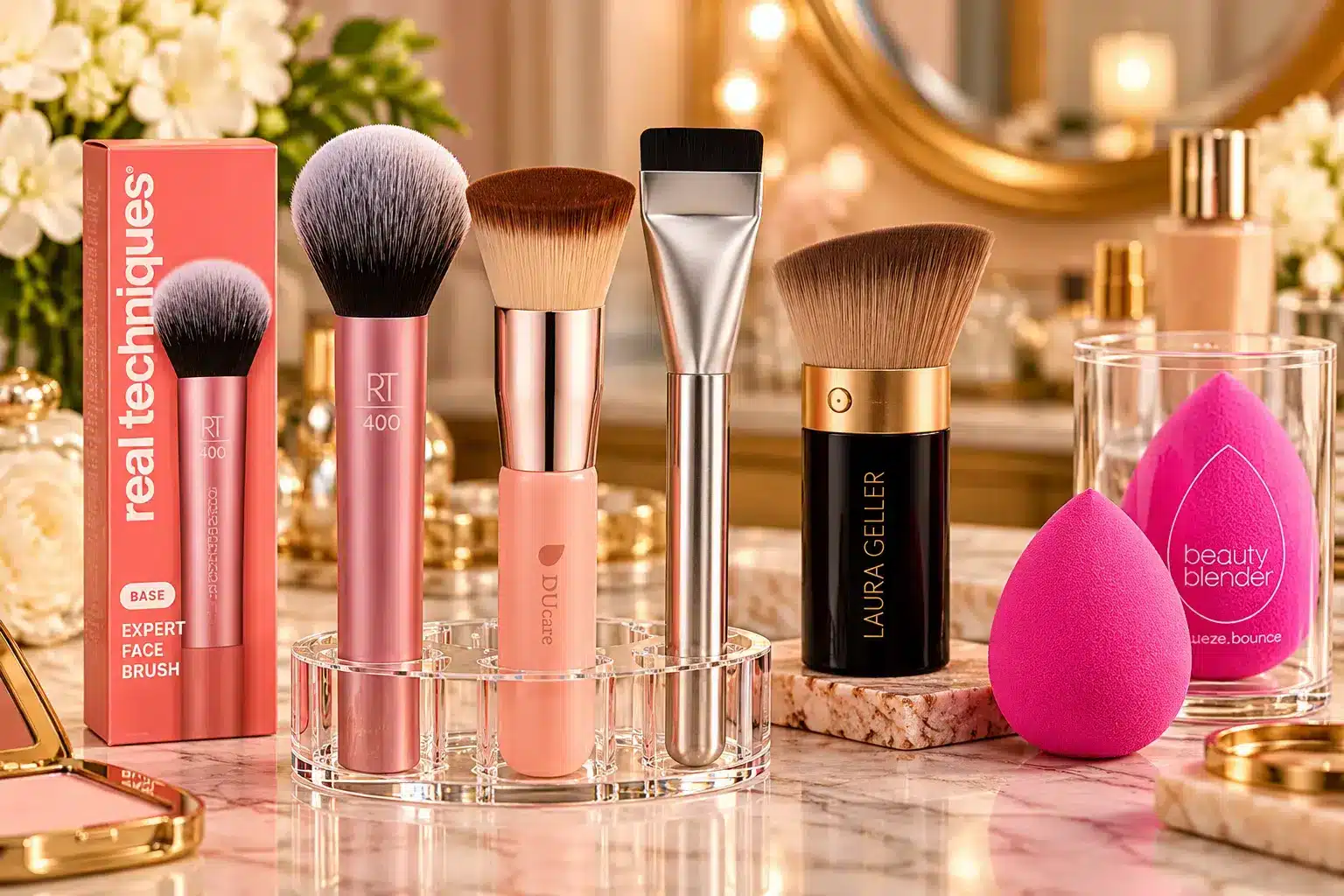
Foundation brushes look deceptively similar until I pay attention to the movement each shape encourages. A flat brush asks me to spread product directionally, a flat-top kabuki invites pressing and buffing, and a contoured head changes how the tool follows the curves of the face.
That is why I do not choose a foundation brush by brand name alone. I start with the application style that feels natural in my hand, then ask whether the brush helps me use less foundation, reach the edges of the face cleanly, and finish the base without needing three corrective tools afterward.
The nine products here cover several distinct approaches. e.l.f., Real Techniques, and EcoTools give me straightforward complexion-brush roles; BK BEAUTY introduces a contoured head; DUcare and Sigma Beauty offer flat-top kabuki formats; BEAUTYFACTOR is explicitly a flat brush for liquid foundation; IT Cosmetics combines flat-top geometry with buffing; and BEAKEY expands the decision into a full brush set with two blending sponges.
I also keep overlap under control. Foundation brushes are one of the easiest tool categories to overbuy because several head shapes can produce similar results once technique is adjusted. I would rather own one brush I understand deeply than five that all perform the same broad job.
My technique starts with product placement, not brush saturation. I put small amounts of foundation where I want coverage, then use the tool to connect and soften those placements. That gives me more control over the final thickness and usually makes the brush easier to clean.
Around the center of the face, I can use the main working surface. Around the nose, mouth, hairline, and jaw, I change angle and use the edge of the brush. A foundation tool becomes more useful when I learn to use more than one part of the head.
The final finish still depends on the foundation formula, skincare underneath, amount of product, and pressure. A brush can improve control, but it does not guarantee that every liquid or cream base will behave the same way.
My favorite foundation brush is therefore the one that disappears from my attention while I am applying makeup. If I am thinking constantly about streaks, pressure, or how to repair the finish, the tool is creating work instead of simplifying it.
Top 3 Foundation Brushes — My Expert Edit

BK BEAUTY
BK BEAUTY 101 Contoured Foundation Brush
- 101 contoured foundation brush
- A contoured foundation-brush shape when I want the brush head to follow facial curves more naturally than a completely flat profile.
- Best for working around cheeks, jawline, nose, and facial contours
- I would choose it only if its shape replaces, rather than duplicates, a brush I already own.

Sigma Beauty
F80 Flat Kabuki Foundation Brush for Liquid and Cream Makeup
- F80 flat kabuki foundation brush for liquid and cream makeup
- A flat kabuki brush when I want one named tool that is explicitly positioned for both liquid and cream makeup.
- Best for liquid-and-cream base application with a flat kabuki format
- I would choose it only if its shape replaces, rather than duplicates, a brush I already own.

IT Cosmetics
IT Cosmetics Heavenly Luxe Flat Top Buffing Foundation Brush #6
- Heavenly Luxe flat-top buffing foundation brush #6
- A flat-top buffing brush when I want the application method to combine a level head shape with a buffing-oriented finish step.
- Best for buffing foundation with a flat-top format
- I would choose it only if its shape replaces, rather than duplicates, a brush I already own.
BK BEAUTY 101 Contoured Foundation Brush is my most shape-specific pick because the contoured head gives me a clear reason to choose it over a conventional flat surface. Sigma Beauty F80 is the strongest flat-kabuki option when I want one brush explicitly identified for both liquid and cream makeup, while IT Cosmetics Heavenly Luxe #6 is the buffing-focused flat-top choice.
The remaining tools cover different needs: e.l.f. is the simple buffing pick, Real Techniques is the one-brush face option, EcoTools stays dedicated to complexion, DUcare gives me another flat-top kabuki route, BEAUTYFACTOR is the directional liquid-foundation brush, and BEAKEY is the full-set choice rather than a single foundation tool.
Foundation Brushes at a Glance

1. e.l.f. Buffing Foundation Brush
- Brand: e.l.f.
- Format: Buffing foundation brush
- Best use: a simple buffing-based foundation routine
- My brush focus: Head shape, movement, product control, edge access, and overlap with tools already owned

2. Real Techniques Expert Face Foundation Makeup Brush
- Brand: Real Techniques
- Format: Expert face foundation brush
- Best use: an all-purpose face-brush role for foundation application
- My brush focus: Head shape, movement, product control, edge access, and overlap with tools already owned

3. EcoTools Wonder Cover Complexion Foundation Brush
- Brand: EcoTools
- Format: Wonder Cover complexion foundation brush
- Best use: a dedicated complexion application step
- My brush focus: Head shape, movement, product control, edge access, and overlap with tools already owned
4. BK BEAUTY 101 Contoured Foundation Brush
- Brand: BK BEAUTY
- Format: 101 contoured foundation brush
- Best use: working around cheeks, jawline, nose, and facial contours
- My brush focus: Head shape, movement, product control, edge access, and overlap with tools already owned
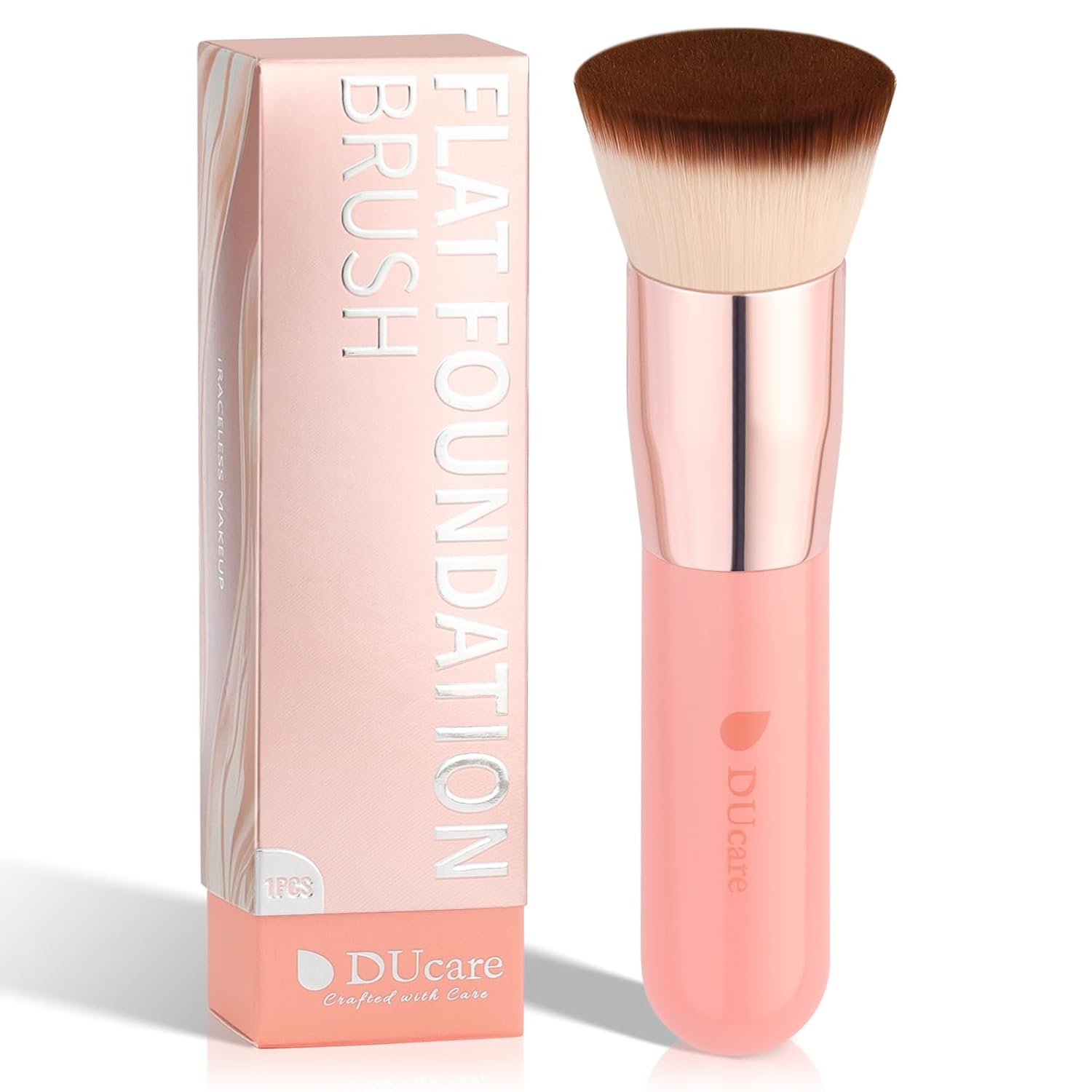
5. DUcare Flat Top Kabuki Foundation Brush
- Brand: DUcare
- Format: Flat-top kabuki foundation brush
- Best use: a flat-top buffing and stippling approach
- My brush focus: Head shape, movement, product control, edge access, and overlap with tools already owned

6. Korean Flat Foundation Brush for Liquid Foundation
- Brand: BEAUTYFACTOR
- Format: Korean flat foundation brush for liquid foundation
- Best use: a liquid-foundation routine built around flat-brush placement
- My brush focus: Head shape, movement, product control, edge access, and overlap with tools already owned
7. F80 Flat Kabuki Foundation Brush for Liquid and Cream Makeup
- Brand: Sigma Beauty
- Format: F80 flat kabuki foundation brush for liquid and cream makeup
- Best use: liquid-and-cream base application with a flat kabuki format
- My brush focus: Head shape, movement, product control, edge access, and overlap with tools already owned
8. IT Cosmetics Heavenly Luxe Flat Top Buffing Foundation Brush #6
- Brand: IT Cosmetics
- Format: Heavenly Luxe flat-top buffing foundation brush #6
- Best use: buffing foundation with a flat-top format
- My brush focus: Head shape, movement, product control, edge access, and overlap with tools already owned

9. BEAKEY Makeup Brushes Set with Two Blending Sponges
- Brand: BEAKEY
- Format: Makeup brush set with two blending sponges
- Best use: someone building a wider tool kit rather than buying one foundation brush
- My brush focus: Head shape, movement, product control, edge access, and overlap with tools already owned
How I Choose a Foundation Brush
Match the Brush to the Motion
Flat brushes favor directional spreading, flat-top kabukis suit pressing and buffing, and contoured heads can feel more natural around facial curves. I choose the movement first.
Use Less Foundation Than You Think
A brush works more cleanly when it is blending a thin layer. I add coverage only where I need it instead of loading the entire face at the start.
Keep Pressure Light Near Texture
More pressure does not automatically create a smoother finish. Around dry areas, pores, or fine texture, I reduce pressure and shorten the blending motion.
Use the Brush Edge for Tight Areas
A broad foundation brush does not have to stay flat against the skin. I turn the head and use its edge around the nose, mouth, hairline, and jaw.
Avoid Owning Three Brushes for One Job
Flat-top foundation brushes overlap quickly. I compare handling, formula compatibility, and facial fit, then keep the tool I naturally reach for most.
Clean Base Brushes on a Real Schedule
Foundation residue builds quickly. I prefer a smaller brush collection that gets washed consistently over a large collection that stays dirty between uses.
Best Luxury Foundation Brushes Detailed Reviews
1. e.l.f. Buffing Foundation Brush
The e.l.f. Buffing Foundation Brush is the most direct opening choice in the group because its job is stated plainly: buffing foundation. I like that clarity when I am deciding whether a tool deserves a permanent place beside my base makeup.
Buffing works best for me when I place small amounts of foundation around the face first and then use the brush to connect those placements. That method helps me avoid loading one section with too much product and gives the brush room to spread the base instead of carrying a heavy pool of formula from one area to another.
I would begin at the center of the face, where I often want the most evening-out, and move outward with controlled circular or short polishing motions. Around the hairline and jaw, I reduce pressure and use whatever remains on the brush rather than adding a fresh amount of foundation.
The word buffing also tells me what I would not use this tool for. I would not choose it because I want a narrow brush for drawing precise lines around the nose or under the brow. Its strength is the broader complexion step, not detail work.
For liquid foundation, I would compare how the brush handles a thin layer before building coverage. For creamier formulas, I would start with even less product because a dense-looking buffing technique can quickly make the base heavier if I overload the face.
I also watch the finish around texture. The solution is rarely harder polishing. If the foundation begins collecting around dry areas or fine texture, I would use less pressure, reduce the amount of product, and work in shorter sections rather than continuing to buff aggressively.
Cleaning matters because a foundation brush repeatedly meets emollient and pigmented products. I would rather wash one dependable brush on a regular schedule than own several similar tools that stay in rotation long enough to build visible residue.
As a first foundation brush, this is easy to understand: place, spread, buff lightly, then stop once the base looks even. I do not need a complicated technique for the brush to make sense.
e.l.f.
A simple buffing brush when I want foundation application to stay uncomplicated
e.l.f. Buffing Foundation Brush
A straightforward buffing brush when I want one dedicated tool for spreading and working foundation across larger areas of the face.
How I Would Use the e.l.f. Buffing Foundation Brush for a Thin, Even Base
- Buffing Foundation Brush
- Dedicated foundation-tool role
- Buffing-oriented application method
- Useful for broad complexion areas
- Works naturally with thin-layer application
- Easy to understand for a one-brush base routine
- Best used with controlled pressure
- Requires regular cleaning because it handles base makeup
e.l.f. Buffing Brush Pros & Cons + The Pressure Mistake I Would Avoid
Pros
- Clear single-purpose role
- Buffing technique can spread small amounts efficiently
- Easy to integrate into a simple foundation routine
- Does not require a large tool collection
- Good starting point for learning pressure control
Cons
- Not intended as a precision detail brush
- Over-buffing can disturb texture or make base look heavy
- Foundation residue makes cleaning important
- May be redundant if a similar buffing brush is already owned
What I would evaluate through repeated application: I would watch how evenly it spreads one thin layer, whether it handles the jaw and hairline without visible buildup, how much pressure the finish tolerates, and whether it replaces another buffing brush instead of duplicating one.
My Foundation-Brush Verdict on the e.l.f. Buffing Foundation Brush
This is my Best Buffing Pick when I want one uncomplicated foundation brush and prefer a polishing application style over narrow paint-like strokes.
2. Real Techniques Expert Face Foundation Makeup Brush
Real Techniques Expert Face Foundation Makeup Brush earns a different place in the lineup because the wording frames it as an expert face brush for foundation. I read that as a tool meant to handle a broad share of the complexion application rather than one tiny area.
When I use one brush as the main base tool, consistency matters more than speed. I would apply foundation in small sections and keep the brush angle similar across the forehead, cheeks, chin, and jaw so the pressure does not change dramatically from one part of the face to another.
I would not use a large amount of product at once. One-brush routines work best when the brush spends more time blending than redistributing excess foundation. Small placements give me time to see whether the formula is already even before adding another layer.
A face brush also needs to navigate transitions. The center of the cheek is simple; the sides of the nose, corners around the mouth, and jawline are where technique becomes more important. I would use the edge of the brush head and shorter motions in those areas instead of forcing the full face of the brush into narrow spaces.
I like foundation brushes that make me simplify the rest of the toolkit. If one face brush can cover most of the base, I do not need separate application and blending brushes unless a formula truly benefits from them.
The main question is whether the tool leaves me wanting a sponge afterward. If I constantly use a sponge to repair visible brush patterns, the brush is not carrying enough of the routine. If a sponge is only an optional finishing step, the brush has a stronger claim on permanent space.
I would also compare it with the e.l.f. Buffing Foundation Brush by technique rather than brand. Both belong to the face-base category, but I would keep whichever shape and movement feel more intuitive in my hand.
For someone who wants one principal foundation brush, this is the kind of product I would evaluate by coverage consistency, edge control, and how often I can finish the base without reaching for a second tool.
Real Techniques
A face-focused foundation brush when I want one main complexion tool
Real Techniques Expert Face Foundation Makeup Brush
A face-focused foundation brush when I want one brush to become the main complexion tool instead of building the routine around several overlapping face brushes.
How I Would Make Real Techniques Expert Face My One-Brush Foundation Routine
- Expert Face Foundation Makeup Brush
- Face-focused foundation role
- Designed around one primary complexion tool
- Useful for broad areas and smaller transitions
- Works well with section-by-section application
- Can be evaluated by whether a sponge remains necessary
- Good fit for a streamlined brush collection
- Foundation-specific naming
Real Techniques Expert Face Pros & Cons + Whether I Still Need a Sponge
Pros
- Strong one-brush complexion role
- Encourages a streamlined routine
- Can cover broad face areas efficiently
- Easy to compare against other main foundation brushes
Cons
- Still requires technique around narrow facial areas
- May overlap with other face or buffing brushes
- Too much product at once can reduce control
- Personal preference for brush angle and movement matters
What I would evaluate through repeated application: I would see whether I can complete the full face with this one brush, how cleanly it handles the nose and mouth area, whether a sponge becomes optional rather than necessary, and whether the brush replaces another face tool.
My Foundation-Brush Verdict on Real Techniques Expert Face
This is my Best Expert Face choice when I want one principal complexion brush rather than several overlapping foundation tools.
3. EcoTools Wonder Cover Complexion Foundation Brush
EcoTools Wonder Cover Complexion Foundation Brush is named around complexion coverage, which makes its place in the routine easy to define. I would choose it when I want one brush that lives beside foundation and does not need a second identity as a blush, bronzer, or powder tool.
A dedicated complexion brush can improve consistency simply because I stop changing technique from day to day. I can learn how much foundation the tool needs, how much pressure works at the cheeks, and how little product is required near the perimeter.
I would apply base to the face rather than saturating the brush first. That keeps me in control of placement and makes cleanup easier because the brush is not carrying more product than the skin actually needs.
For the center of the face, I would use short, overlapping motions. Toward the outer cheeks, temples, and jaw, I would soften the pressure and let the remaining foundation fade gradually rather than creating a sharp edge.
I would also pay attention to how the brush behaves around areas where foundation tends to collect. More product is usually not the answer around the nose, smile lines, or dry patches. I prefer a lighter layer and a smaller movement pattern.
The phrase Wonder Cover gives the brush a strong name, but I would not convert that wording into a guarantee of a specific coverage level. Coverage still comes from the foundation formula, amount used, and application technique.
This brush makes the most sense for someone who likes a dedicated station for complexion products. If I already own several foundation brushes that all serve the same broad role, the better decision may be to keep the one whose shape I use most consistently.
I would judge this product by repeatability: can I recreate the same even base several mornings in a row without thinking too much about the tool? That matters more to me than having multiple brushes with slightly different names.
EcoTools
A complexion-specific brush when I want the tool role to stay centered on foundation
EcoTools Wonder Cover Complexion Foundation Brush
A complexion brush when I want the tool choice to stay centered on foundation rather than drifting into contour, blush, or powder tasks.
How I Would Build a Repeatable Base With EcoTools Wonder Cover
- Wonder Cover Complexion Foundation Brush
- Dedicated complexion role
- Foundation-specific naming
- Useful for section-by-section base application
- Works with a light-pressure perimeter technique
- Supports a streamlined complexion brush category
- Coverage depends on formula and technique
- Best for someone who wants one dedicated foundation tool
EcoTools Wonder Cover Pros & Cons + Why Coverage Still Depends on the Foundation
Pros
- Clear complexion purpose
- Encourages consistent technique
- Useful for controlled thin-layer application
- Easy to assign a permanent foundation-only role
Cons
- Wonder Cover wording is not a coverage guarantee
- Can overlap with other complexion brushes
- Still needs careful work around texture and narrow areas
- Not useful as a broad multi-category tool if foundation is rarely worn
What I would evaluate through repeated application: I would compare how consistently it creates an even base, whether the perimeter fades cleanly with less pressure, how much product the brush needs, and whether its dedicated role simplifies or merely expands my brush collection.
My Foundation-Brush Verdict on Wonder Cover Complexion Brush
This is my Best Complexion Pick when I want a foundation-only brush and value repeatable technique more than a multi-purpose tool.
4. BK BEAUTY 101 Contoured Foundation Brush
BK BEAUTY 101 Contoured Foundation Brush stands apart because contoured is the defining shape term. I would choose this style when I want the brush head to work with the curves of the face instead of approaching every area with one flat plane.
The cheeks are where a contoured shape seems most intuitive to me. I can keep a broader section of the brush in contact with the face while changing angle as I move toward the nose, under the cheekbone, and down toward the jaw.
Shape alone does not create a better finish, though. I would still use small amounts of foundation and let the brush geometry guide placement rather than pressing harder. A well-shaped tool loses its advantage if I overload the product or force the head into areas it does not fit.
Around the nose, I would use a smaller portion of the brush rather than the entire surface. Around the jaw, I would work with the natural contour and use the last traces of foundation to soften the transition toward the neck.
This is also the brush I would compare most carefully with flat-top options. A flat top gives me a broad level surface; a contoured head gives me a shape designed around changing facial planes. The better choice depends on which movement feels more natural in my hand.
I would not assume the contoured shape automatically reaches every detail. Foundation brushes still have limits, and very tight areas may need the edge of the brush, a finger, or a smaller tool if precision matters.
The value of this design appears if the shape reduces the amount of repositioning I do while blending. If I can maintain smooth contact across more of the face, the brush may make the application feel more fluid.
For someone already comfortable with foundation brushes, this is a more shape-specific choice. I would buy it because the contouring of the brush head solves a real handling preference, not simply because 101 sounds like a flagship model.
BK BEAUTY
A contoured foundation brush when I want the head shape to follow the face more deliberately
BK BEAUTY 101 Contoured Foundation Brush
A contoured foundation-brush shape when I want the brush head to follow facial curves more naturally than a completely flat profile.
How I Would Use the BK BEAUTY 101 Contour of the Brush Head Around Facial Curves
- 101 Contoured Foundation Brush
- Contoured brush-head concept
- Dedicated foundation role
- Designed around facial curves
- Useful for cheek, jaw, and nose transitions
- Alternative to flat-top geometry
- Best evaluated by handling and angle control
- BK BEAUTY foundation tool
BK BEAUTY 101 Pros & Cons + Contoured Versus Flat-Top Handling
Pros
- Distinct contoured shape concept
- Can feel natural across changing facial planes
- Easy to differentiate from flat-top brushes
- Good choice for someone who values brush-head geometry
Cons
- Shape preference is highly personal
- Still may need edge work around tight areas
- Contoured design does not replace good product control
- Can duplicate another foundation brush if both are used identically
What I would evaluate through repeated application: I would compare how naturally the head follows my cheeks and jaw, whether it reduces repositioning, how cleanly the edge handles the nose area, and whether I prefer its geometry enough to keep it over a flat-top brush.
My Foundation-Brush Verdict on the BK BEAUTY 101
This is my Best Contoured Pick when brush-head shape is the main reason I want to upgrade from a more conventional foundation brush.
5. DUcare Flat Top Kabuki Foundation Brush
DUcare Flat Top Kabuki Foundation Brush is defined by two useful terms: flat top and kabuki. That makes it one of the clearest technique-driven choices in the lineup because the head shape naturally suggests pressing, stippling, and controlled buffing.
I would begin by dotting a small amount of foundation around the face and pressing the brush lightly over those areas. Once the product is distributed, I would switch to small circular or short buffing motions rather than using long paint-like strokes.
The flat surface is most useful across broader areas such as the cheeks and forehead. Around the nose and mouth, I would turn the brush slightly and use the perimeter of the head instead of forcing the entire top into a narrow space.
A kabuki-style routine can become heavy when too much foundation is applied at once. I prefer to build coverage in thin layers. The brush should be moving product that is already close to the skin, not pushing a thick layer around until it finally looks even.
I would compare this directly with the Sigma F80 because both are flat-kabuki foundation brushes in the lineup. The decision should come down to which tool feels easier to control, how the dimensions suit my face, and which one fits the budget and collection better.
I would also compare it with the IT Cosmetics flat-top buffing brush. Those two names emphasize flat top plus buffing, whereas the DUcare product uses the kabuki identity. In practice, I would keep the brush whose movement feels most natural and avoid owning several tools that solve the same job.
Cleaning a flat-top foundation brush is especially important because the working surface repeatedly handles pigmented base products. I would rinse thoroughly enough that old foundation does not remain trapped in the head and change the next application.
This is the value-focused flat-top choice for someone who knows that stippling and buffing are already preferred techniques and does not need a more specialized contoured geometry.
DUcare
A flat-top kabuki when I want a level surface for stippling and buffing
DUcare Flat Top Kabuki Foundation Brush
A flat-top kabuki format when I want a broad, level contact surface for pressing, stippling, or buffing foundation rather than painting it on in narrow strokes.
How I Would Use the DUcare Flat Top Kabuki for Stippling Before Buffing
- Flat Top Kabuki Foundation Brush
- Level working surface
- Foundation-specific tool
- Suitable for stippling motions
- Suitable for controlled buffing
- Useful on broad facial areas
- Edge of head can assist around narrow areas
- Direct comparison point with other flat-top brushes
DUcare Flat Top Kabuki Pros & Cons + How I Would Avoid Overloading the Base
Pros
- Very clear technique and shape identity
- Broad surface suits complexion application
- Works naturally with thin-layer building
- Easy to compare with premium flat-kabuki options
Cons
- Flat top may feel less intuitive than a contoured head for some users
- Can make foundation heavy if overloaded
- Several similar flat-top brushes in the lineup create overlap
- Requires thorough cleaning after base products
What I would evaluate through repeated application: I would compare stippling control, buffing smoothness, edge access around the nose, and whether the tool offers enough difference from the Sigma and IT Cosmetics flat-top options to justify keeping it.
My Foundation-Brush Verdict on the DUcare Flat Top Kabuki
This is my Best Flat-Top Value when I want a clear kabuki-style foundation technique without turning the brush collection into a luxury-only purchase.
6. Korean Flat Foundation Brush for Liquid Foundation
BEAUTYFACTOR Korean Flat Foundation Brush for Liquid Foundation is the most format-specific main pick because the wording identifies both a flat brush style and liquid foundation as the intended base category.
I would use a flat foundation brush differently from a kabuki. Instead of starting with circular buffing, I would place and spread thin strokes of liquid foundation across the face, working from the center outward and keeping the layer light.
That directional application can be useful around the sides of the nose, under the cheekbone area, and near the jaw because the brush can be turned to work with its edge. I would keep the stroke length short so the finish does not develop obvious striping.
After the foundation is distributed, I would use gentle cross-directional strokes or a separate finishing motion to soften any visible lines. A flat brush can be excellent for placement, but the final blending step determines whether the result looks seamless.
I would not use more foundation simply because the brush can carry it. Liquid base can move quickly across the skin, so the best control often comes from fewer drops or dots and more deliberate spreading.
This is also a good reminder that foundation-brush preference is partly about hand movement. Some people naturally like painting and smoothing motions; others prefer stippling and circular buffing. Neither method is universally superior.
I would choose this over a flat-top kabuki if I like to see exactly where the foundation is being placed before I blend it out. If I prefer to press and polish immediately, one of the kabuki options may feel more intuitive.
For a routine built around liquid base, the brush has a clear identity. Its value comes from matching the tool style to the application movement I already enjoy.
BEAUTYFACTOR
A flat liquid-foundation brush when I want directional placement before blending
Korean Flat Foundation Brush for Liquid Foundation
A flat brush specifically identified for liquid foundation when I want a more directional application style and a tool chosen around liquid base.
How I Would Use the BEAUTYFACTOR Flat Brush to Place Liquid Foundation Before Final Blending
- Korean Flat Foundation Brush
- Explicit liquid-foundation wording
- Flat-brush application style
- Directional placement role
- Edge can assist around narrower areas
- Best used with short controlled strokes
- Different technique from flat-top kabuki brushes
- Foundation-specific tool
BEAUTYFACTOR Flat Foundation Brush Pros & Cons + How I Would Control Streaks
Pros
- Clear liquid-foundation role
- Directional placement can feel precise
- Edge can help near nose and jaw transitions
- Useful for people who prefer smoothing strokes over circular buffing
Cons
- Flat brushes can show streaks if blending stops too early
- Not designed around cream makeup in the stated wording
- May require a separate finishing motion
- Technique preference determines whether it feels natural
What I would evaluate through repeated application: I would look at how easily I can place liquid foundation without streaks, whether the edge helps around the nose and jaw, and whether I finish the base with the same brush or repeatedly reach for a sponge afterward.
My Foundation-Brush Verdict on the Korean Flat Foundation Brush
This is my Best Liquid Pick when I prefer a flat, directional application style and want the tool choice centered specifically on liquid foundation.
7. F80 Flat Kabuki Foundation Brush for Liquid and Cream Makeup
Sigma Beauty F80 Flat Kabuki Foundation Brush is the main product whose wording explicitly covers both liquid and cream makeup. That makes it the broadest formula-specific flat-kabuki option in the group.
I would use the F80 as a press-then-buff tool. For liquid foundation, I would dot a small amount around the face and use the flat head to distribute it. For cream makeup, I would pick up less product at a time and build slowly so the base does not become thick.
The flat-top format gives me a predictable contact area. On broad sections of the cheek or forehead, I can keep the head level. Around the nose and mouth, I would tilt the brush and work with the perimeter rather than trying to make the entire top fit.
Because the tool is identified for liquid and cream, I would pay close attention to cleaning if I switch formulas. Creamier base can leave more visible residue, and old product can change how the brush picks up and redistributes the next foundation.
I would compare the F80 with the DUcare flat-top kabuki by technique and with the IT Cosmetics flat-top buffing brush by movement. All three occupy related territory, so the best decision is to choose one primary flat-top tool rather than assume the collection needs every version.
The strength of a flat kabuki is efficiency across broad areas, but that efficiency can become over-application. I would stop after the first even layer, look at the skin from a little distance, and add coverage only where needed.
I also like the idea of using the same brush family across liquid and cream makeup because it keeps my hand technique consistent. The formula changes, but the basic press, spread, and buff sequence can remain familiar.
This is the strongest choice when formula versatility matters more than a contoured head or a traditional flat-brush stroke.
Sigma Beauty
A flat kabuki foundation brush when liquid and cream makeup both need one tool
F80 Flat Kabuki Foundation Brush for Liquid and Cream Makeup
A flat kabuki brush when I want one named tool that is explicitly positioned for both liquid and cream makeup.
How I Would Switch the Sigma F80 Between Liquid and Cream Foundation Without Changing the Whole Technique
- F80 Flat Kabuki Foundation Brush
- Liquid makeup wording
- Cream makeup wording
- Flat-kabuki format
- Broad complexion contact surface
- Useful for pressing and buffing
- Formula-versatile foundation role
- Sigma Beauty foundation tool
Sigma F80 Pros & Cons + Why Formula Versatility Can Still Create Brush Overlap
Pros
- Explicitly suited to liquid and cream makeup in the wording
- Flat-kabuki technique is easy to understand
- Broad surface can make complexion application efficient
- One brush can cover two named formula categories
Cons
- Can overlap strongly with other flat-top brushes
- Broad head still needs edge work around narrow areas
- Easy to build too much coverage if product is overloaded
- Needs careful cleaning when alternating liquid and cream formulas
What I would evaluate through repeated application: I would compare its control with both liquid and cream foundation, see whether the same technique works comfortably across formulas, and decide whether it can replace other flat-top brushes rather than join them.
My Foundation-Brush Verdict on the Sigma F80 Flat Kabuki
This is my Best Flat Kabuki choice when I specifically want one foundation brush whose wording covers both liquid and cream makeup.
8. IT Cosmetics Heavenly Luxe Flat Top Buffing Foundation Brush #6
IT Cosmetics Heavenly Luxe Flat Top Buffing Foundation Brush #6 combines two of the most important technique clues in one name: flat top and buffing. That tells me both how the working surface is shaped and how the brush is meant to move across the complexion.
I would use the flat surface first to distribute foundation across larger areas, then reduce the pressure and buff in small motions to finish. The transition matters because I do not want to polish the skin aggressively while a thick layer of product is still sitting on top.
A brush like this makes sense when I prefer one tool to handle both placement and finishing. I would still work in sections, especially with formulas that begin setting before I have blended the entire face.
The number 6 identifies the model, but I would not attach extra performance claims to it. What matters in this comparison is the flat-top buffing concept and whether that style feels more natural than the contoured BK BEAUTY head or the directional BEAUTYFACTOR flat brush.
I would also compare how the brush feels around the perimeter. A broad flat head can make cheeks and forehead easy, but the jaw, hairline, and nose require smaller movements. I use the remaining foundation on the brush for those transitions instead of adding more.
If I need a sponge every time to remove visible brush texture, I would reconsider the technique before blaming the tool. Less foundation, lighter pressure, and shorter sections can often make a bigger difference than adding another applicator.
This is the premium-feeling buffing role in the group, but the decision should still be practical. If I already love another flat-top brush, I want a clear handling advantage before adding a second one.
For someone who enjoys the flat-top format and wants buffing to be the main finishing motion, the product identity is unusually easy to understand.
IT Cosmetics
A flat-top buffing brush when I want the head shape and finishing motion aligned
IT Cosmetics Heavenly Luxe Flat Top Buffing Foundation Brush #6
A flat-top buffing brush when I want the application method to combine a level head shape with a buffing-oriented finish step.
How I Would Use IT Cosmetics Heavenly Luxe #6 From First Placement to Final Buffing
- Heavenly Luxe brush line
- Flat Top wording
- Buffing Foundation Brush
- Brush #6 model
- Foundation-specific tool
- Combines broad contact with buffing technique
- Useful for placement followed by polishing
- Direct comparison with other flat-top options
Heavenly Luxe #6 Pros & Cons + When a Premium Flat-Top Brush Is Actually an Upgrade
Pros
- Shape and movement are both clear from the name
- One brush can handle placement and finishing motions
- Flat top suits broad complexion areas
- Strong choice for people who already like buffing
Cons
- Overlaps with other flat-top brushes
- Broad head still needs careful edge work
- Buffing can disturb texture if pressure is too high
- May be unnecessary if a similar brush is already a favorite
What I would evaluate through repeated application: I would compare how smoothly it transitions from product placement to final buffing, whether it handles facial edges without forcing extra tools, and whether it offers enough handling difference from other flat-top brushes to deserve its place.
My Foundation-Brush Verdict on IT Cosmetics Heavenly Luxe #6
This is my Best Buffing Upgrade when I want a flat-top foundation brush whose entire identity is built around a buffing finish.
9. BEAKEY Makeup Brushes Set with Two Blending Sponges
BEAKEY Makeup Brushes Set with Two Blending Sponges is the outlier in the main nine because it is not one dedicated foundation brush. It is a broader brush set, and the inclusion of two blending sponges makes the tool strategy completely different.
I would consider this if I were starting a brush collection, replacing several worn tools at once, or setting up a second makeup kit. I would not compare it directly with a single Sigma F80 or BK BEAUTY 101 as though the products solve identical needs.
The useful foundation angle is that a broader brush set can give me more than one application pathway. I can use an appropriate face brush for initial placement and keep a blending sponge for pressing or refining the base afterward.
That flexibility can be valuable for someone still learning which foundation method feels best. A single brush forces an early commitment to one head shape; a set allows experimentation across several tools, although the exact role of each brush still needs to be learned.
The danger is clutter. A large set can make the vanity look complete while only a handful of tools get used. I would identify the foundation brush, the main powder or cheek brush, the essential eye tools, and the two sponges before deciding whether the set earns its space.
I would also avoid using every included brush simply because it exists. A good tool kit should reduce friction, not create a requirement to use ten brushes for a routine that previously needed four.
The two blending sponges are the clearest supported foundation-related accessory in the wording. I would use them when I want to press or refine base, but I would still clean them regularly and let them dry completely between uses.
This is the best choice in the main list for someone who wants a whole toolkit. For someone who already owns a mature brush collection and only needs a better foundation brush, a single dedicated tool is the more efficient purchase.
BEAKEY
A full brush-set option when I am building a makeup toolkit rather than buying one foundation brush
BEAKEY Makeup Brushes Set with Two Blending Sponges
A set-based option when I want foundation tools to sit inside a broader brush collection and also want blending sponges included.
How I Would Edit the BEAKEY Brush Set Down to the Tools I Would Actually Use
- Makeup Brushes Set
- Two blending sponges included
- Broad toolkit rather than one dedicated foundation brush
- Useful for someone starting or replacing a brush collection
- Allows more than one foundation application method
- Can support brush-plus-sponge complexion technique
- Needs role assignment to avoid tool clutter
- Best evaluated as a set, not as one brush
BEAKEY Brush Set Pros & Cons + When a Full Toolkit Makes More Sense Than One Foundation Brush
Pros
- Broad toolkit in one purchase
- Two blending sponges explicitly included
- Useful for beginners building several tool categories
- Allows experimentation with brush and sponge techniques
Cons
- Not a dedicated foundation-brush purchase
- Large sets can include tools that remain unused
- Harder to compare directly with single foundation brushes
- Requires more cleaning and storage than one tool
What I would evaluate through repeated application: I would identify which tools become weekly staples, whether the included sponges add real value to foundation application, and whether the set reduces missing-tool problems without creating a drawer full of unused brushes.
My Foundation-Brush Verdict on the BEAKEY Set With Two Blending Sponges
This is my Best Set Option when I need a broader makeup-tool collection and want blending sponges included, not when I am simply replacing one foundation brush.
Some Other Alternative Brands’ Products
These four alternatives use brands that do not appear in the main nine. KESHIMA is the direct foundation-brush alternative; Morphe, Laura Geller New York, and BS-MALL are broader brush-set options, so I label them as toolkits instead of pretending they are single foundation brushes.

KESHIMA
KESHIMA Flat Top Kabuki Foundation Brush
Best Exact Brush Alternative. A flat-top kabuki foundation brush from a brand not used in the main nine. This is the closest like-for-like alternative because the tool is explicitly identified as a foundation brush.

Morphe
Morphe Best of Blends 8 Piece Makeup Brush Set
Best Blending-Set Alternative. An eight-piece brush set for someone who wants a broader blending collection. I treat it as a toolkit alternative rather than pretend every brush in the set is a foundation brush.

LAURA GELLER NEW YORK
LAURA GELLER NEW YORK Full Face Brush Set, 5 Pieces
Best Full-Face Set Alternative. A five-piece full-face brush set when the goal is to build several complexion and color-tool roles at once instead of buying one foundation brush.

BS-MALL
BS-MALL Professional Makeup Brush Set, 18 Pieces
Best Large-Set Alternative. An 18-piece professional makeup brush set for someone starting or replacing a larger tool wardrobe. It is a broad set alternative, not a foundation-only tool.
Final Comparison
| # | Product | Brand | Best For | Application Direction | Shop |
|---|---|---|---|---|---|
| 1 | e.l.f. Buffing Foundation Brush | e.l.f. | Best Buffing Pick | Buffing foundation brush | Amazon |
| 2 | Real Techniques Expert Face Foundation Makeup Brush | Real Techniques | Best Expert Face | Expert face foundation brush | Amazon |
| 3 | EcoTools Wonder Cover Complexion Foundation Brush | EcoTools | Best Complexion Pick | Wonder Cover complexion foundation brush | Amazon |
| 4 | BK BEAUTY 101 Contoured Foundation Brush | BK BEAUTY | Best Contoured Pick | 101 contoured foundation brush | Amazon |
| 5 | DUcare Flat Top Kabuki Foundation Brush | DUcare | Best Flat-Top Value | Flat-top kabuki foundation brush | Amazon |
| 6 | Korean Flat Foundation Brush for Liquid Foundation | BEAUTYFACTOR | Best Liquid Pick | Korean flat foundation brush for liquid foundation | Amazon |
| 7 | F80 Flat Kabuki Foundation Brush for Liquid and Cream Makeup | Sigma Beauty | Best Flat Kabuki | F80 flat kabuki foundation brush for liquid and cream makeup | Amazon |
| 8 | IT Cosmetics Heavenly Luxe Flat Top Buffing Foundation Brush #6 | IT Cosmetics | Best Buffing Upgrade | Heavenly Luxe flat-top buffing foundation brush #6 | Amazon |
| 9 | BEAKEY Makeup Brushes Set with Two Blending Sponges | BEAKEY | Best Set Option | Makeup brush set with two blending sponges | Amazon |
What I Would Evaluate Over 30 Days With a Foundation Brush
A foundation brush can feel excellent for one application and still prove redundant after several weeks. I would use a month to judge consistency, cleanup, formula fit, and whether the brush earns a role that another tool does not already fill.
My Final Recommendation
BK BEAUTY 101 Contoured Foundation Brush is my most distinctive shape-led choice because the contoured head gives it a clear reason to exist beside flatter brushes. Sigma Beauty F80 is my strongest flat-kabuki option when I want one tool explicitly positioned for both liquid and cream makeup, and IT Cosmetics Heavenly Luxe #6 is the buffing-focused flat-top option.
e.l.f. is the simple buffing pick, Real Techniques is the one-brush face option, EcoTools is the dedicated complexion choice, DUcare gives me a value-oriented flat-top kabuki, BEAUTYFACTOR is the directional liquid-foundation brush, and BEAKEY is the broader set choice with two blending sponges.
The alternatives add KESHIMA as the closest like-for-like foundation brush, plus broader brush sets from Morphe, LAURA GELLER NEW YORK, and BS-MALL. I would choose a set only when several tool categories are missing; otherwise, one well-matched foundation brush is usually the cleaner purchase.
Frequently Asked Questions
Is a flat-top foundation brush better than a flat foundation brush?
Not universally. A flat-top brush suits pressing, stippling, and buffing, while a traditional flat brush suits directional spreading and smoothing. I choose based on the hand movement I prefer.
Which main brush is explicitly for liquid and cream makeup?
Sigma Beauty F80 Flat Kabuki Foundation Brush is the main product whose wording explicitly states liquid and cream makeup.
Which main brush is specifically identified for liquid foundation?
BEAUTYFACTOR Korean Flat Foundation Brush is explicitly identified for liquid foundation.
Which brush has a contoured head?
BK BEAUTY 101 is the main selection explicitly described as a Contoured Foundation Brush.
Which options are flat-top or kabuki-style brushes?
DUcare is a Flat Top Kabuki, Sigma F80 is a Flat Kabuki, and IT Cosmetics Heavenly Luxe #6 is a Flat Top Buffing Foundation Brush.
Do I need a sponge after using a foundation brush?
Not necessarily. A sponge can be an optional finishing tool, but I first adjust foundation amount, brush pressure, and blending motion before assuming a second applicator is required.
How much foundation should I put on the brush?
I prefer placing small amounts on the face and using the brush to spread them. Starting thin gives me better control and reduces the risk of a heavy finish.
Is the BEAKEY product a single foundation brush?
No. It is a makeup brush set with two blending sponges, so I treat it as a broader toolkit option rather than a direct one-brush comparison.
Which alternative is an actual foundation brush?
KESHIMA Flat Top Kabuki Foundation Brush is the closest like-for-like alternative because it is explicitly identified as a foundation brush.
How many foundation brushes do I really need?
For most routines, one primary brush and perhaps one genuinely different backup shape are enough. I avoid collecting several flat-top tools that all solve the same job.
Read More Beauty Articles
More reads from our Makeup collection, selected for their related topics and keywords.

Best Luxury Blush Brushes
A blush brush looks simple until cheek color starts landing too low, too wide, too concentrated, or in a shape that does not match the…
Read More
Best Luxury Makeup Sponges
A makeup sponge looks simple until I try to make one tool handle foundation, concealer, cream color, touch-ups, and finishing work without turning the routine…
Read More
How to Make Foundation Last All Day
Foundation usually fails in small places before it fails everywhere. The nose becomes shiny, the chin separates, smile lines collect product, or the center of…
Read More
Best Estée Lauder Double Wear Foundation Review
Estée Lauder Double Wear deserves a focused review before any alternatives enter the conversation. The useful questions are how the foundation spreads in a thin…
Read More
Best Luxury Makeup Sets Under $100
Hi, I’m Elena Hart . Beauty is my favorite kind of conversation—part artistry, part discovery, and always personal. Stay with me; I’ll help you look…
Read More
Best Luxury Makeup Gift Sets
Luxury makeup is easy to buy for yourself and surprisingly difficult to give well. The challenge is not finding a beautiful palette; it is choosing…
Read More
Best Luxury Makeup Sets for Beginners
The easiest beginner makeup bag is rarely the biggest one. Too many shades, brushes, finishes, and specialty steps can make a simple morning routine feel…
Read More
Best Luxury Skin Tints & Lightweight Alternatives
A good skin tint should make me look more even without making me feel as though I put on a full foundation and then tried…
Read More